
FairAudit Flow Early access
Compliance where your engineers write tickets.
While a ticket is written, Flow suggests acceptance criteria tied to the article they come from, asks at most three questions about facts only your team knows, and logs every decision as evidence.
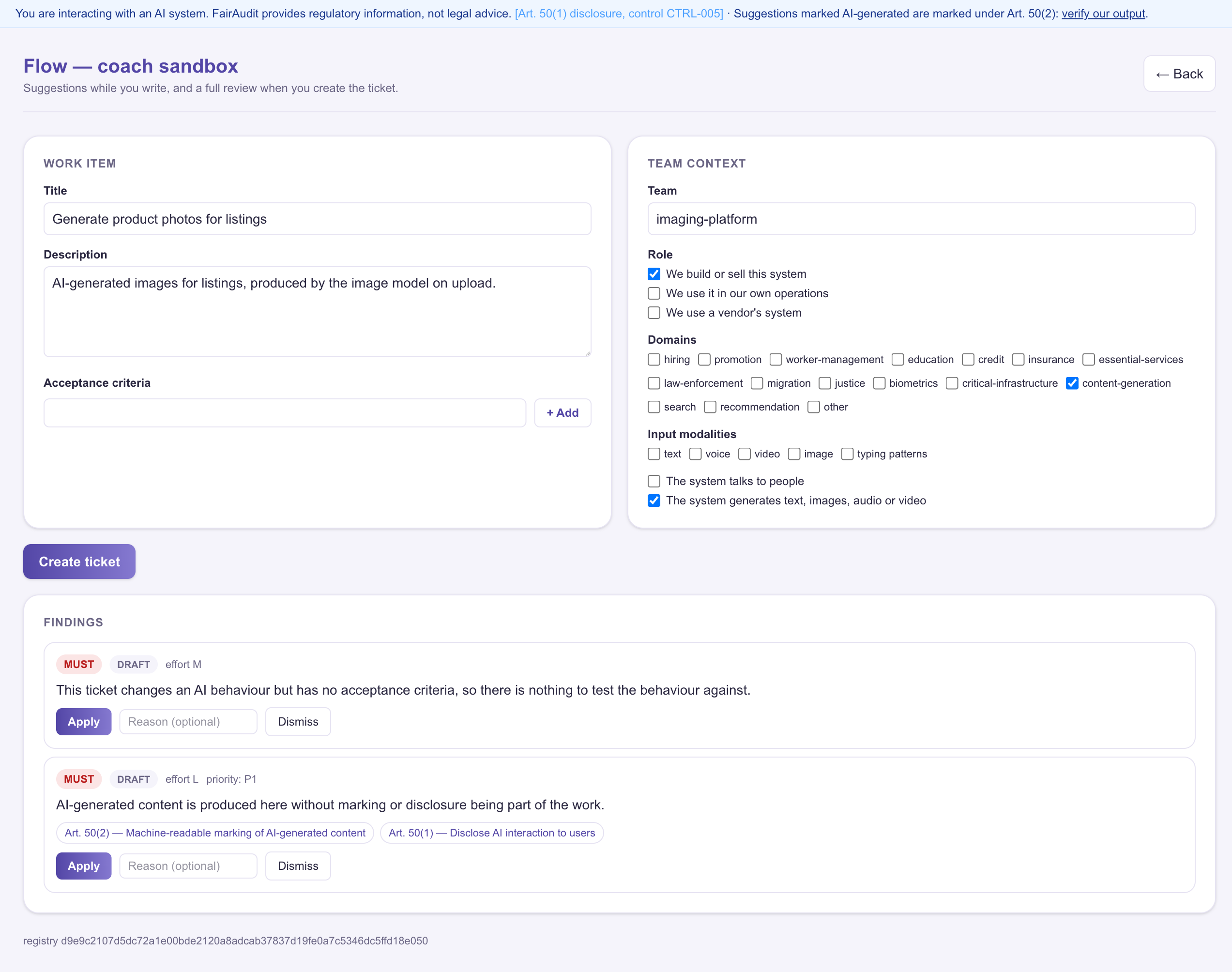
- 1 Facts only the team knows
- 2 The articles the suggestion comes from
- 3 Apply or dismiss. Both are logged.
How it works
-
A ticket is written
An engineer describes the work as usual. Checks run while they type.
-
A cited suggestion
Flow proposes an acceptance criterion, tied to the article it comes from.
-
The decision is logged
Apply it or dismiss it. Both are logged as evidence, with the reason when one is given.
Between the policy and the sprint board, governance evaporates.
The policy is decided upstairs. What reaches the board is a ticket that says “comply with the AI Act”, assigned to an engineer left to work out what that means for this feature. Teams asked for the checks where the work is written, not in a separate tool.
What Flow does
While the ticket is written
Checks run as the engineer types and suggest acceptance criteria, each tied to the obligation it comes from. No model is involved at this step, so the same ticket always gets the same answer.
When facts are missing
Flow asks at most three questions, and only about facts your team knows: do you build or sell this, in which area, with which inputs. It never asks you to classify yourself legally. It works that out.
Apply or dismiss
One click turns an obligation into a testable criterion. A dismissal records its reason. Both are logged as evidence, and the number a pilot is judged on is suggestions applied, divided by suggestions shown.
Silence on purpose
A plain bug fix gets no suggestions. Tools that flag everything get muted, so staying quiet when nothing applies is part of the design, and it is in the test set.
The rules it holds to
In place, not a lecture
Feedback is the rewritten acceptance criterion, ready to accept or edit. Never a reading assignment.
Citations from the registry
Flow can only cite an article the obligation registry knows, and checks that on every request. Where it cannot verify, it says so.
Current when the law moves
The registry is the one RegWatch keeps verified, so a new obligation reaches the ticket without a code change.
Where it stands
What exists
The engine, the ticket surface, the checks and the questions, the evidence log, and the number a pilot is judged on.
What does not, yet
It is switched off in production. A model-based review of the whole ticket is being tuned and stays off until it is quiet. Estimating hours and re-ordering the backlog are on the roadmap, not in the code.
Flow and Audit are never sold to the same client. If we help build your process, we do not audit its results.
Want Flow in your workflow?
Apply for the pilot, or book a call and tell us where compliance work gets lost in yours.
The assistant: sign in with your email. We confirm access by email. The high-risk obligations for hiring systems, Article 14 included, apply from 2 December 2027. Regulatory information, not legal advice.